Why consumer codes matter
A heat pump installation usually involves a deposit, payments in stages, weeks between signing and finishing, and a warranty that has to outlast the installer's interest in the job. Consumer codes are the rules an installer agrees to follow on all of these. For the grant scheme they are not optional: Ofgem's guidance says installers working with consumers must be MCS certified and members of a consumer code approved by the Secretary of State, and lists three as relevant.
HIES
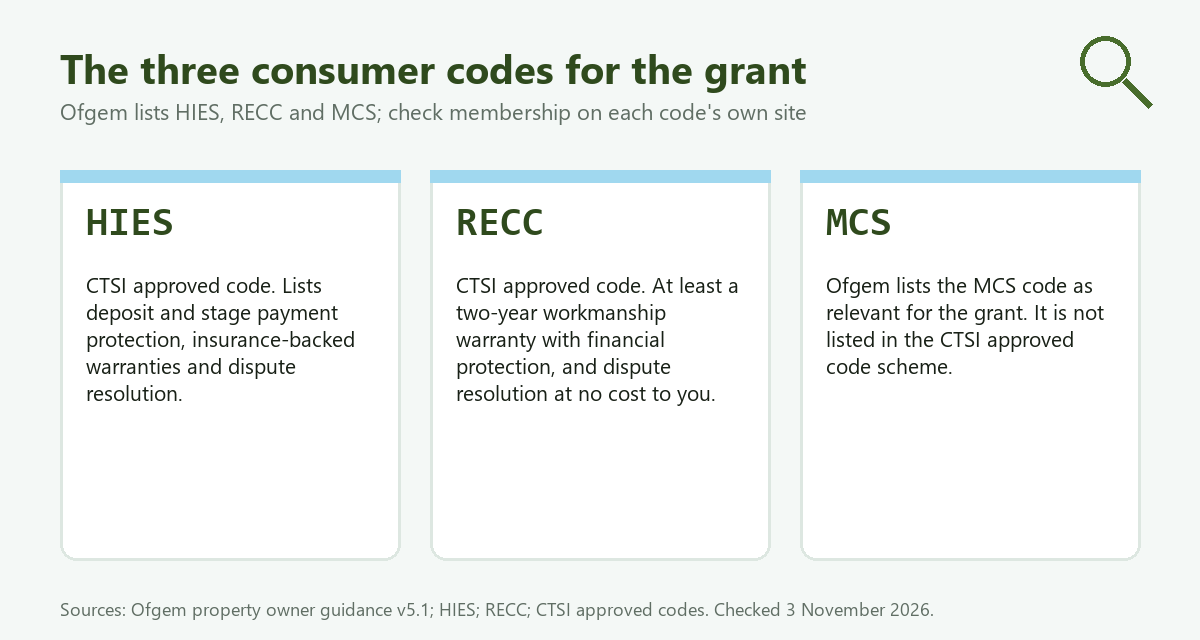
HIES says its accredited installers operate under a consumer code approved by the Chartered Trading Standards Institute (CTSI). The protections it lists for homeowners include deposit and stage payment protection, insurance-backed warranties and alternative dispute resolution. HIES has its own "Find an Installer" page where membership can be checked.
RECC
RECC, the Renewable Energy Consumer Code, is also CTSI approved. RECC says all members must provide a workmanship warranty of at least 2 years, with financial protection if the installer fails to fix a problem or stops trading. It offers dispute resolution, through Green Homes Dispute Resolution, at no cost to the consumer, and says that in many cases you have 14 days to cancel. Its directory can be searched by postcode, technology or name.
MCS
Ofgem lists the MCS consumer code as relevant to the grant scheme alongside HIES and RECC. The CTSI's approved code list for renewable energy shows HIES and RECC, not MCS. That does not stop an MCS code member taking part in the grant, but it is a reason to read exactly what that code offers on deposits, warranties and disputes before you sign.
Checking membership
- Ask the installer which consumer code it belongs to.
- Go to that code's own website and search for the firm.
- Note the protections the code lists, and check the installer's quote and contract reflect them.
A logo on a firm's website or van is not evidence of membership. The code's own search is.
Side by side
| Code | Approved by CTSI | What it lists for homeowners |
|---|---|---|
| HIES | Yes | Deposit and stage payment protection; insurance-backed warranties; dispute resolution |
| RECC | Yes | Workmanship warranty of at least 2 years with financial protection; dispute resolution at no cost; in many cases 14 days to cancel |
| MCS | Not in the CTSI list | Listed by Ofgem as relevant to the grant; read the code itself |
Whichever code applies, keep the contract, the deposit receipt and any warranty documents together. If you ever need to use the code's dispute process, those are the papers it will ask for. The page on complaints and disputes sets out the order to go in.
What a workmanship warranty covers
A workmanship warranty is the installer's promise to put right problems caused by its work, such as a leaking joint or a fault in how the system was set up, for a period after the job. It is separate from the manufacturer's warranty on the heat pump itself. RECC requires its members to give one of at least 2 years, and says it comes with financial protection if the installer fails to fix a problem or stops trading. That last part matters: a warranty from a firm that no longer exists is worth only what protects it.
Deposit protection in practice
HIES lists deposit and stage payment protection among the protections for homeowners. The point of deposit protection is that money paid before the work is finished is not simply lost if the installer cannot complete it. Ask the installer how your deposit is protected under its code, and keep the receipt with the contract.
Codes and the grant
The grant scheme requires installers working with consumers to belong to a consumer code approved by the Secretary of State, which is why Ofgem's guidance lists the three. In practice this means a firm that is not in any of them cannot apply for the grant for you. If a firm offers you the grant but cannot name its code, that is reason enough to check further before going on.
If a firm changes or leaves its code
Membership can lapse. Check the code's site close to the time you sign, not months earlier, and note the date you checked on your check sheet. If a firm has left its code, ask why, and remember that the grant needs a code member.
Using the code if you need it
If a problem cannot be settled with the installer, the code is your next step. Have the contract, payment receipts, warranty documents and your correspondence ready. The complaints and disputes guide sets out the order to go in, and what to put in a complaint.
Checking membership on the code's own website
Every consumer code keeps a list or search of its members. Look the firm up there by name, not through a link on its own website, and check that the name and address match the quote. If a firm says it is "applying" or "about to join", ask when; a firm that is not yet a member cannot offer the code's protections on your contract.
What a code does not do
A consumer code sets standards for how members sell, contract and handle complaints. It does not certify the technical design of a heat pump, which is MCS's role, and it does not sign off building regulations work, which comes through a competent person scheme or building control. Nor can it recover money from a firm that was never a member. That is why the code check sits beside the register check rather than replacing it.
A consumer code is one check among several. Finding MCS installers shows how to confirm certification on the register, check an installer puts every check in order, and comparing quotes explains how a code's deposit rules should show up in the paperwork.