Pass one: the design
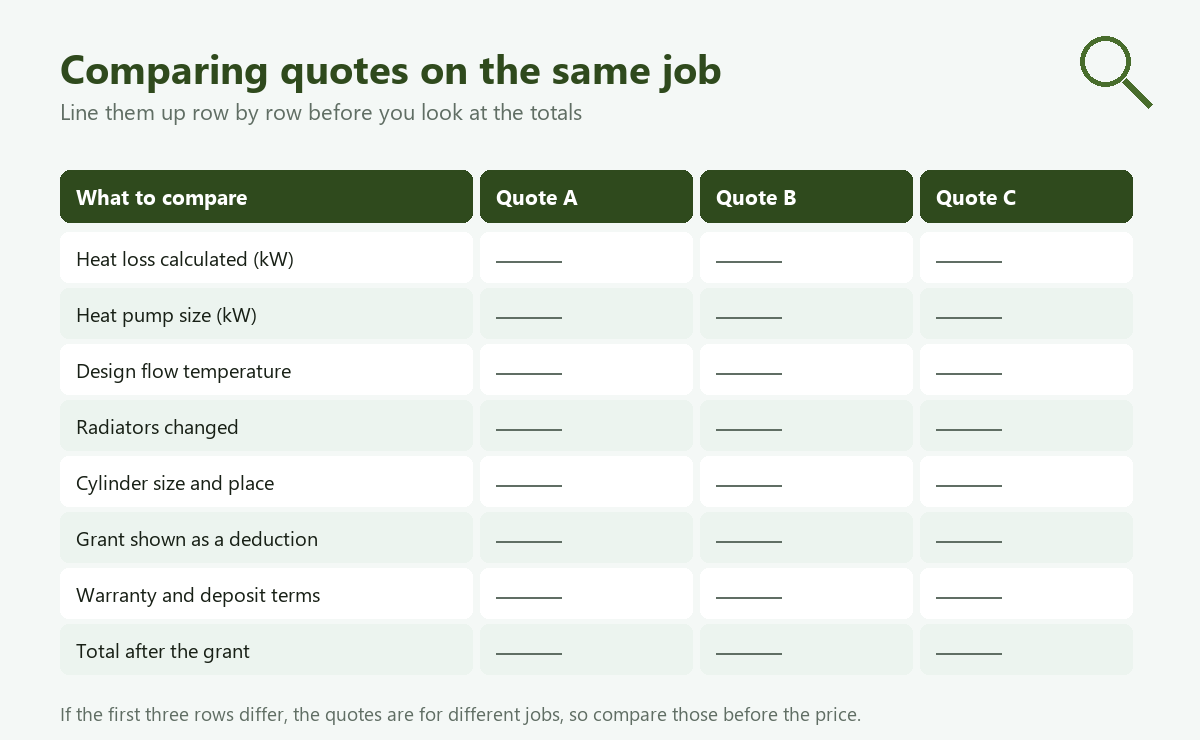
Before any price, check whether the quotes describe the same system. Five things decide that:
| Line | What to look for |
|---|---|
| Heat loss calculated | The total, in kW, and whether it was done room by room. MCS certified installers design to MIS 3005-D. |
| Heat pump size | Should match the heat loss. A much bigger unit costs more without adding comfort. |
| Design flow temperature | Lower usually means more efficient running but bigger radiators. |
| Radiators changed | Which rooms, and what replaces each radiator. |
| Cylinder | Its size and where it goes. |
If two quotes differ here, ask each installer to explain its figures. Often one has assumed different insulation or a different indoor temperature. Getting both on the same basis is worth a phone call, because everything else follows from it.
Pass two: the money and the terms
- The grant line. Each quote should show the grant as a deduction. Ofgem's guidance says the quote should be clear and itemised, and the rules stop installers asking you for the grant amount unless the application is refused or the voucher revoked. For most homes that qualify the grant is £7,500.
- The total after the grant. That is what you pay.
- Warranty. The workmanship warranty and who stands behind it. RECC members must give at least 2 years with financial protection.
- Deposit and stages. How much is paid when, and how any deposit is protected.
- Timing. When the work would happen, and how long the heating would be off.
Itemised or not
A quote that gives only a single total makes comparison almost impossible. Ask for the main parts as separate lines: the heat pump, the cylinder, radiator work, pipework, controls, electrical work, labour, commissioning and the grant deduction. Installers who design to a standard will have these figures; asking for them is normal.
When quotes differ a lot
Differences of a few thousand pounds are common. As a reference point only, the official median price reported for grant-funded air source heat pump installations in July to September 2026 was £12,826 (DESNZ), and half of all jobs fell between £10,717 and £15,461. A quote well outside that range is not necessarily wrong, but it should explain itself: a larger home, more radiators, a difficult pipe run or an electrical upgrade.
Making the choice
Once two quotes describe the same design and both firms pass the register and code checks, the choice is genuinely yours: price, timing, how clearly each firm explained its design, and how it answered your questions. Keep all the quotes and the check sheet together. And before signing, read the warning signs one last time.
Reading the heat-loss figure
The heat-loss figure is the number most worth understanding, because every other line of the design follows from it. It is the heat, in kW, that the house is calculated to lose on a cold design day. Two things can make two installers' figures differ: what they assumed about the house (insulation, windows, draughts) and what they assumed about you (the temperature you want in each room). Neither is wrong in itself. Ask each installer to tell you the main assumptions, and if one has assumed loft insulation you do not have, or warmer rooms than you want, the figures will diverge for a reason you can fix.
Three questions to send every installer, in writing
- What total heat loss did you calculate, and what indoor and outdoor temperatures did you assume?
- What design flow temperature is the system designed for, and which radiators change as a result?
- What is the full itemised price, the grant deduction, and the total I pay?
Sending the same three questions to each installer puts the answers side by side in a form you can compare, and the way each firm answers says something too.
When only one quote is possible
Sometimes only one certified installer is available within a reasonable time. You can still check it properly: run the register and code checks, ask for the design in writing, and compare its price with the official median as a rough sense check. A single quote that is clear, itemised and backed by a written design is a better basis for a decision than three vague ones.
Timing and availability
Availability is a fair thing to weigh, but weigh it last. A firm that can start next week but will not put its design in writing is a worse bet than one that needs a month and answers every question. If the grant is involved, remember that once the installer applies and the voucher is issued, the work has a time limit; a start date that is too far off can matter. Ask each firm when it would apply, when it would fit, and how that fits the voucher's deadline.
Writing down what each quote leaves out
Quotes differ as much in what they leave out as in what they include. Make a short list for each one: radiators not priced, electrical work marked "to be confirmed", making good after pipework, removing the old boiler or tank, access equipment, and any notification paperwork. Ask each firm to price those items or to say in writing that they are included. A quote that looks cheaper often becomes the dearer one once the gaps are filled, and a firm that answers these questions quickly and clearly is showing you how it is likely to run the job itself.
Prices only compare fairly once each firm has passed the checks in check an installer and each quote rests on a written design, which the survey visit questions help you get. Anything in a quote that matches the warning signs is worth querying before you sign.